
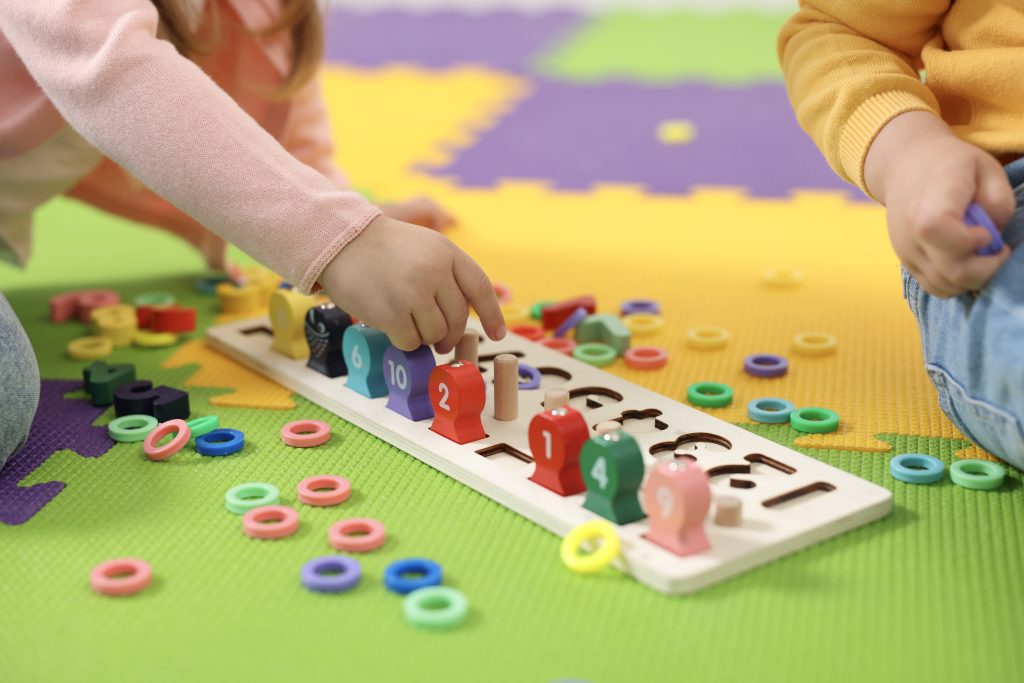
A child avoiding math at this age isn’t necessarily a reflection of their ability; it can also be about confidence. A child who seems hesitant with math may benefit from more small, low-pressure opportunities to explore numbers and build confidence. Whether you’re choosing a preschool in Singapore for the first time or wondering what’s missing at your child’s current one, the good news is that confidence can be built, both at home and in the right classroom. Here’s what that actually looks like.
How Can a Preschool Help Build a Child’s Confidence in Math?
Confidence in math can be built through small, frequent wins with real objects and everyday language, rather than relying solely on worksheets or repetitive practice. Children can begin exploring ideas about quantity, size, and patterns through ordinary play. A play-based preschool can build on these experiences, turning everyday moments into low-pressure opportunities to practise. Here’s what that can look like.
What Everyday Activities Build Number Sense?
Simple, everyday moments can give children valuable opportunities to develop number sense. Counting steps on the way up the stairs, spotting numbers on lift buttons, or counting down while waiting for the bus are all everyday moments that build this skill. These are the kinds of small routines families can explore at home and through learning experiences in our preschools across Singapore. These moments work because they use real objects your child already understands, rather than abstract symbols on a page. You don’t need special training or materials — the ordinary parts of your day are already full of opportunities.
How Does Play-Based Learning Support Early Math Skills?
Play does more than keep children entertained. Building with blocks, completing puzzles, and playing sorting games can give children opportunities to explore patterns, make comparisons, and engage in early problem-solving. At My Little Campus’s preschools in Pasir Ris, Yishun, Bedok Reservoir, and Sembawang, our hands-on curriculum uses visual aids and physical materials through play-based learning to help children build these foundations naturally, as part of a broader focus on Mathematics, Science, English, and Mandarin.
Why Does Praising Effort Matter More Than Getting the Right Answer?
Praising effort matters more than getting the right answer because it helps children see mistakes as part of learning and encourages them to keep trying when math feels challenging. Instead of focusing only on whether your child gets the right answer, praise their effort and willingness to try. If your child is counting to ten but gets a number out of order, try praising them for trying rather than only celebrating a perfect count. Over time, this kind of encouragement can help children feel more comfortable trying something they’re unsure about, building their confidence.
What Should You Look for in a Preschool That Builds Early Math Skills?
With so many preschools in Singapore to choose from, it helps to look past labels like “the best” and focus on what you can actually observe for yourself. What matters more is finding the best fit for your child, and that usually comes down to a few observable things: how teachers respond when a child gets something wrong, how much hands-on math material — such as counters, blocks, or number lines — is actually visible in the classroom, and whether the daily routine includes opportunities for play alongside more guided activities. These are things you can see for yourself, rather than take on faith from a brochure.
How Do You Know If a Preschool’s Curriculum Is Right for Your Child?
A curriculum can look impressive in writing and still feel very different once you’re standing in the classroom. Rather than relying on a prospectus, ask to see a sample daily schedule and pay attention to how academic activities and play are balanced throughout the day. It’s something we’re happy to walk parents through at any of our preschool locations. A visit lets you see these details for yourself, making it easier to decide whether the preschool feels like the right fit for your child.
What Should You Ask During a Preschool Tour?
A few specific questions can tell you more than a general tour ever will. Try asking how teachers respond when a child gets an answer wrong, how often hands-on materials like blocks or counters are used in a typical day, and what a normal math-related activity actually looks like for your child’s age group. If you’re near Bedok Reservoir, Pasir Ris, Sembawang, or Yishun, book a tour to ask us these questions in person.
What Does Everyday Math Confidence Actually Look Like at Our Preschool?
At My Little Campus, confidence looks less like getting every answer right and more like a child willing to try. It’s a child attempting to count their own snacks without being asked twice, noticing on their own that the red blocks and blue blocks make a pattern, or saying “I can try” instead of “I can’t” when something feels new. These small shifts build gradually, through repeated, low-pressure moments rather than any single lesson, which is exactly why the everyday environment around your child matters so much.
Ready to See This in Action?
If your child has been avoiding numbers or saying they’re ‘not good at math,’ remember that this doesn’t necessarily reflect their ability or mean they’ll always feel this way. At My Little Campus, we build math confidence across all four of our centres through everyday play, encouragement, and plenty of hands-on practice. Find a centre near you to see this approach for yourself and meet the team who’ll be working with your child.